
Your outbound team is dialing. The numbers are going out. The metrics show activity. But the conversations aren’t happening at the rate they should.
Most sales managers respond to this problem by adjusting the wrong variables. They rewrite scripts. They change dialing windows. They try new lead sources. They hire different reps. None of these efforts make a significant impact, as they fail to address the root cause of the problem within the carrier network prior to any ring reaching your prospect’s phone.
If your team is already dealing with the visible symptoms of this problem, the “Spam Likely” problem is a valuable place to start understanding what you’re up against. This post delves deeper into the carrier-level mechanics that dictate the visibility of your calls.
To understand why calls go unanswered in 2026, one must comprehend the fundamental changes carriers have made in their handling of outbound call traffic. This is not a story about consumer behavior or lead quality. It is a story about infrastructure, specifically, the three gatekeepers that now sit between your dialer and your prospect’s phone and the signals they use to decide whether your call deserves to be heard.
How the Carrier Network Evaluates Every Call You Place

Every outbound call placed in the United States travels through a chain of telecommunications infrastructure before it reaches its destination. At the originating end, your telephony provider signs the call with a digital certificate under the STIR/SHAKEN caller authentication framework, the FCC-mandated caller authentication protocol established by the TRACED Act. This certificate assigns an attestation level that travels with the call through the network.
At the terminating end, the recipient’s carrier receives the call, verifies the attestation, and then passes it through its analytics engine before deciding how to handle it. That analytics engine does not simply check whether the call is authentic. It evaluates a behavioral profile built from historical calling patterns, consumer feedback signals, and real-time network data. Based on that evaluation, the carrier makes one of three decisions: deliver the call cleanly, attach a warning label, or block it entirely.
This process happens in milliseconds, before the phone rings, before any human makes a decision about answering. By the time your prospect sees their screen, the carrier has already determined the context in which your call will be received.
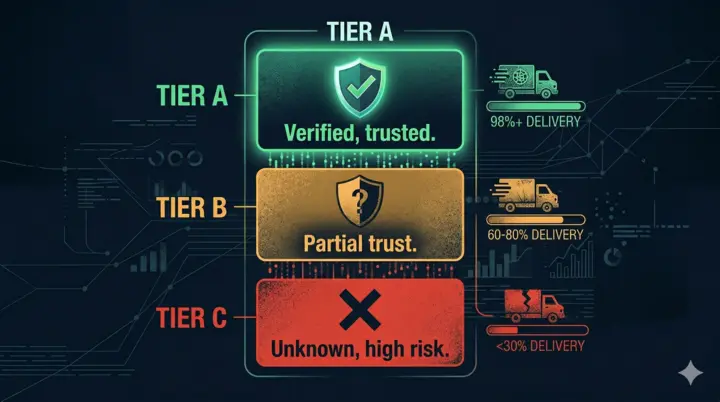
The attestation framework provides the foundation of this evaluation. Under STIR/SHAKEN, calls receive one of three attestation levels. Full attestation at the A level means the originating carrier has verified that the number belongs to the business placing the call and that the business is authorized to use it. Partial attestation at the B level means the carrier knows the customer but cannot fully verify their authorization to use that specific number. Gateway attestation at the C level means the carrier has no established relationship with the calling party at all.
According to the TNS 2026 Robocall Investigation Report, 85% of all voice traffic between Tier-1 carriers was signed and verified with STIR/SHAKEN protocols in 2025, with 93% of that signed traffic carrying A-level attestation. Smaller carriers significantly lag behind, with only 17.5% of traffic between them signed. This means that depending on your telephony provider, a meaningful percentage of your calls may be traveling through the network without proper authentication, setting them up for labeling before they reach anyone.
Attestation, however, is only the first layer. A call with full A-level attestation can still be labeled as spam. The reason is that STIR/SHAKEN verifies identity but does not evaluate behavior. The analytics engines that operate at the carrier level handle the behavioral evaluation separately.
The Gatekeepers: Hiya, TNS, and First Orion

The three major carriers in the United States, AT&T, T-Mobile, and Verizon, do not operate their spam detection algorithms in-house. They contract with specialized analytics companies that monitor call patterns across billions of calls, build reputation scores for phone numbers, and make labeling recommendations that carriers apply in real time.
These three companies are the actual gatekeepers of your outbound calling program.
Hiya provides call analytics for AT&T and powers the spam detection layer on a significant portion of Android devices. Hiya’s network analyzes calling behavior across its platform and assigns reputation scores to phone numbers based on factors including call volume per number, answer rate, call duration patterns, and consumer complaint signals from its app user base. When a number crosses Hiya’s threshold for suspicious behavior, it triggers a label on AT&T’s network, typically “Spam Risk” or “Likely Spam,” that appears on the recipient’s screen before they decide whether to answer.
TNS (Transaction Network Services) handles analytics for Verizon’s network. TNS operates the Call Guardian product and publishes an annual Robocall Investigation Report that provides some of the most detailed public data available on call labeling trends. TNS evaluates similar behavioral signals to Hiya but applies its own proprietary thresholds and scoring methodology. A number that is clean on AT&T’s network can be labeled on Verizon’s based on different historical data and different consumer feedback signals from Verizon customers.
First Orion powers T-Mobile’s spam detection and also operates the PrivacyStar and Call Protect consumer products. First Orion takes a slightly different approach, incorporating business verification data alongside behavioral signals. It manages the branded calling infrastructure that allows verified businesses to display their company name, logo, and reason for calling on T-Mobile customer devices, a feature that meaningfully improves answer rates for businesses that qualify for it.
The critical implication of this three-gatekeeper structure is that a phone number’s reputation is not a single score. It is three separate scores, maintained independently by three separate organizations, evaluated against three separate sets of behavioral data. A number can be clean on one network and labeled on another. When your outbound team reports poor answer rates without investigating network-specific performance, they are flying blind.
Each gatekeeper evaluates the same core behavioral signals, though their weighting and thresholds differ. High call volume concentrated on a single number raises flags across all three. Low answer rates, particularly below 15 to 20 percent, signal to carrier analytics engines that flag suspicious call patterns that recipients are actively avoiding the number, which is treated as strong evidence of unwanted calling behavior. Short call durations, where calls end in under 30 seconds on a consistent basis, reinforce this pattern. Calls without proper STIR/SHAKEN authentication receive automatic suspicion. Consumer complaints filed through spam-reporting apps or directly with carriers accelerate flagging significantly.
Once a label is applied, the damage compounds. A labeled number generates more unanswered calls. More unanswered calls lower the answer rate. Lower answer rates strengthen the spam signal. The algorithm flags the number more aggressively. This self-reinforcing cycle is why labeled numbers rarely recover and why the conventional response of simply getting new numbers fails without addressing the underlying infrastructure.
Legacy vs. Adaptive Dialing: A Comparison

The behavioral signals that trigger carrier labeling are not arbitrary. They are precisely the behaviors that characterize legacy dialing systems, systems designed when carrier filtering was minimal and high-volume, concentrated dialing was an acceptable operational strategy.
Understanding the contrast between legacy and adaptive dialing approaches explains why some outbound operations consistently achieve strong answer rates while others with similar lead quality and similar products cannot break 15 percent.
| Dimension | Legacy Dialing | Adaptive Dialing |
|---|---|---|
| Number pool | Small, shared, or recycled | Large, dedicated, registered |
| Per-number velocity | 200–500+ calls per day | Capped within carrier thresholds (~75–150/day) |
| Number registration | None or self-registered | Carrier-whitelisted with analytics providers |
| STIR/SHAKEN attestation | B or C level, inconsistent | A-level, consistent across all calls |
| Spam monitoring | Reactive (after damage is done) | Continuous, proactive number health scoring |
| Number replacement | Manual, after complaints surface | Automated, before answer rates degrade |
| Local presence | None or static | Dynamic, matched to recipient geography |
| Call duration management | No controls | Velocity rules prevent ultra-short call spikes |
| Carrier-specific reputation | Untracked | Monitored separately across Hiya, TNS, First Orion |
| Answer rate outcome | 10–20% in typical operations | 40–65% with managed infrastructure |
The gap between these two approaches is not primarily a technology gap. It is an infrastructure management gap. Legacy dialing concentrates calling behavior on small numbers of lines without regard for the behavioral signals those patterns send to carrier analytics engines. Adaptive dialing distributes call volume across large, managed number pools in ways that look, to the algorithms, like the behavior of legitimate, measured outbound communication.
Branded calling capabilities, available through First Orion and Hiya for verified businesses, add another layer of improvement on top of adaptive dialing. When a call arrives with a verified business name, logo, and reason for calling displayed on the recipient’s screen, the decision to answer shifts from “I don’t know who the caller is” to “I can see exactly who this is and why they’re calling.” The behavioral lift from branded calling is real and documented, though it requires carrier-level business verification rather than simply configuring a caller ID display.
What Happens When Your Number Gets Flagged
The labeling process is not always visible to outbound operations until the damage is substantial. Most call center platforms report total dials and total conversations. They do not break down answer rates by carrier network or flag the moment a number begins accumulating negative reputation signals.
The typical pattern looks like this: answer rates begin declining gradually, usually attributed internally to seasonal factors, lead quality variation, or call timing. By the time the decline becomes undeniable, the numbers responsible may have been labeled for weeks. Every call placed from those numbers during the degradation period added to the negative behavioral signal rather than contributing to revenue.
The conventional response, acquiring new numbers, fails to address the root cause if the dialing infrastructure remains unchanged. New numbers introduced into the same high-velocity, unregistered calling environment will develop the same reputation profile on the same timeline. In some cases, new numbers begin flagging within hours of being put into active rotation, because carrier algorithms also factor in number age and calling behavior from day one.
A permanent solution requires changing the infrastructure, not just the numbers. That means registering dedicated numbers with carrier analytics engines, distributing call volume across a large enough pool to keep per-number velocity within acceptable thresholds, monitoring reputation scores on a network-by-network basis, and implementing automated number lifecycle management that removes flagged lines before they damage campaign performance.
The Compliance Connection
There is a feedback loop between TCPA compliance for AI calling and carrier reputation that most outbound operations do not fully understand.
Calls placed outside permitted dialing windows, before 8 AM or after 9 PM in the recipient’s local time zone, for example, generate higher rates of consumer complaints and rejections. These complaints feed directly into carrier analytics engines, accelerating reputation degradation for the numbers involved. A single campaign that violates state-level calling restrictions does not just create legal exposure. It actively damages the amount of health that determines your answer rates on future calls.
This means that compliance infrastructure and number reputation management are not separate concerns. They are components of the same operational system. An outbound program automatically enforces TCPA compliance framework at the system level across federal and state-specific rules produces better behavioral signals as a direct consequence of its compliance posture. Fewer complaints. Higher answer rates on legitimate contacts. Slower reputation degradation over time.
The inverse is equally true. An outbound program that relies on manual checks for compliance or makes mistakes that violate state rules leads to the exact problems that carrier analytics engines pay the most attention to.
Building an Answer Rate Your Revenue Can Rely On
The path from poor answer rates to strong ones is not a matter of finding better leads or writing better scripts. It is a matter of building the infrastructure that sends the right signals to carrier analytics engines and maintaining that infrastructure continuously as calling patterns evolve and carrier algorithms update.
The businesses achieving 40 to 65 percent answer rates on outbound AI calling programs in 2026 do not rely on clever scripts or lucky timing. They achieve this by using special pools of registered numbers that follow the right speed limits for carriers, ensuring every call has top-level STIR/SHAKEN verification; constantly checking their reputation across Hiya, TNS, and First Orion networks separately; replacing numbers before they get flagged for poor performance; and enforcing rules that cut down on consumer complaints right from the start
As an AI outbound calling solution built specifically for high-volume regulated industries, Bigly Sales manages every component of this infrastructure on behalf of our clients before a single call is placed. Number acquisition, carrier registration, local presence deployment, velocity management, spam monitoring, and automated number lifecycle management are not configuration options — they are the foundation of how the platform operates. The result is answer rate performance that reflects actual lead quality rather than infrastructure failure.
Book a Free Demo to see what your answer rates look like when carrier infrastructure is managed properly.
Frequently Asked Questions
Q1: Why do outbound calls show up as “Spam Likely” even when the business is legitimate?
Carrier analytics engines evaluate behavioral patterns rather than intent. A legitimate business that concentrates high call volume on a small number of lines, generates low answer rates, or places calls without A-level STIR/SHAKEN attestation will trigger the same spam signals as an actual robocaller. The algorithm cannot distinguish good intentions from bad; it can only read behavioral data. Proper number management, registered carrier whitelisting, and controlled per-number velocity are the technical responses to this problem, not script adjustments or dialing time optimization.
Q2: What is the difference between Hiya, TNS, and First Orion?
Hiya, TNS, and First Orion are the three analytics companies that provide spam detection services for AT&T, Verizon, and T-Mobile, respectively. Each maintains its own independent database of phone number reputation scores, built from behavioral signals and consumer feedback across its network. A number’s reputation is therefore three separate scores, not one. Outbound operations that fail to monitor carrier-specific performance cannot identify which network is driving poor answer rates or apply targeted remediation.
Q3: Does STIR/SHAKEN A-level attestation prevent spam labels?
A-level attestation significantly reduces the risk of spam labeling but does not eliminate it. STIR/SHAKEN verifies caller identity; it confirms that the number belongs to a legitimate business and that the business is authorized to use it. Carrier analytics engines then evaluate behavioral signals independently of attestation levels. A properly attested number can still receive a spam label if it places calls at high velocity or generates low answer rates. Attestation is a necessary foundation, not a complete solution.
Q4: How long does it take for a labeled number to recover its reputation?
Recovery of phone number reputation is slow and unreliable. Carrier analytics scores improve gradually when a number demonstrates sustained positive behavior over time, healthy answer rates, appropriate velocity, and no consumer complaints. In practice, most labeled numbers never fully recover to their pre-flagging performance. The operationally sound approach is proactive replacement of flagging numbers before they are fully labeled, not remediation after the fact.
Q5: What is adaptive dialing, and how is it different from regular outbound dialing?
Adaptive dialing spreads out the number of outgoing calls over large, managed pools of dedicated, registered phone numbers. This keeps the speed of each number within the limits set by the carrier. It incorporates continuous reputation monitoring, automated number lifecycle management, A-level STIR/SHAKEN attestation, and local presence matching. Traditional or legacy dialing concentrates volume on small, often shared number pools without carrier registration or reputation monitoring. The behavioral difference between these two approaches is precisely what carrier analytics engines are designed to detect, and the answer rate outcomes reflect that gap directly.

Stephan is the sports journalist for the Maple Grove Report.