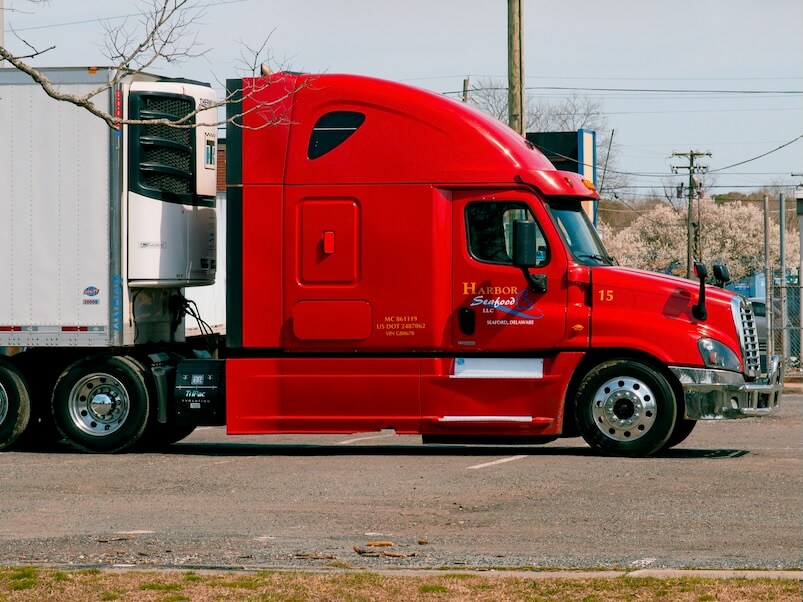
Semi-trucks need longer stopping distances because of their extraordinary weight and the physics that follow from it. A fully loaded commercial truck can tip the scales at 80,000 pounds. That mass generates momentum that no braking system can instantly overcome. At highway speeds, a loaded semi needs roughly 40% more road to stop than a car traveling beside it.
That gap gets really vast when you look at the truck stopping distance vs. car stopping distance in actual numbers. A passenger car at 65 mph stops within about 316 feet under good conditions. A fully loaded semi at the same speed needs somewhere between 525 and 600 feet.
That’s not a flaw in the truck’s design. It’s the combined result of momentum, brake system mechanics, and load variation, all stacking against the driver at once.
In this article, let’s explore more.
It Comes Down to Weight and Momentum
Newton’s second law helps explain the problem clearly. Heavier vehicles need more force to slow down. A fully loaded semi-truck carries huge momentum at highway speeds, so its brakes must work much harder to stop it even when they are in good condition.
The Federal Motor Carrier Safety Administration (FMCSA) requires commercial trucks to stop within 250 feet from 60 mph under controlled test conditions. Real-world roads don’t offer controlled conditions.
Wet pavement, worn brakes, and downhill grades can push stopping distance well past that threshold without anything technically breaking down. The regulation sets a legal minimum, not a safe maximum.
The Mechanics Behind Truck Brake Lag
Passenger cars use hydraulic disc brakes; press the pedal, and the response is nearly instant. Semi-trucks run on air brake systems, and that difference matters more than most drivers realize.
When a truck driver hits the brake pedal, compressed air has to travel through a network of lines before reaching each wheel. That process takes between 0.4 and 0.5 seconds. At 65 mph, the truck covers around 50 feet before a single wheel starts slowing down.
Air brakes are built for long-haul reliability and hold up well when properly maintained. But the delay is structural. A truck will always take longer to begin stopping than a car, no matter who’s driving.
Load Weight Doesn’t Just Add Distance; It Compounds It
More cargo doesn’t produce a proportional increase in stopping distance. The relationship compounds. Here’s how load level affects braking in practice:
- Empty truck: Less momentum, but reduced axle weight lowers tire grip and raises skid risk.
- Partially loaded truck: Uneven weight distribution can destabilize braking, especially through curves.
- Fully loaded truck (80,000 lbs): Peak momentum, longest stopping distances, maximum stress on brake components.
- Overloaded truck: Brakes can overheat and fade—braking force drops sharply and doesn’t recover until the system cools.
Brake fade is a serious hazard on mountain grades. This is why experienced truckers downshift and use engine braking on long descents rather than riding the brakes down. Riding the brakes is a fast path to losing them.
Weather and Reaction Time Add Hundreds of Feet
Under 49 CFR Part 393, federal law requires commercial vehicles to meet specific braking standards based on weight class and vehicle type. Those standards are measured on dry, flat pavement. Most highways aren’t.
Rain drops tire friction significantly. Ice can eliminate it. A truck that stops in 525 feet on a dry road might need 700 feet or more on wet pavement. Factor in the driver’s own perception and reaction time, and you add another 140 to 190 feet before braking even starts.
In poor weather, a fully loaded semi at highway speed may need more than 800 feet to stop completely. That’s over a quarter mile from the moment the driver sees a problem.
What Every Driver Around a Truck Should Know
Understanding how semi-trucks stop can help you drive more safely around them. Cutting in front of a truck, braking suddenly near one, or merging too closely takes away the space the driver needs to stop safely.
With vehicles that large and heavy, even a small loss of distance can become dangerous. A truck driver can do everything right and still not have enough road left. Physics doesn’t bend for good intentions. What matters is whether the people around that truck gave it enough space to work with.
Key Takeaways
- The weight and the physics are the reasons why semi-trucks need longer stopping distances.
- Heavier vehicles need more force to slow down.
- The FMCSA requires trucks to stop within 250 feet from 60 mph.
- Passenger cars use hydraulic disc brakes, while semi-trucks run on an air brake system.
- Understanding these factors can help you drive more safely.
People also read this: Booked Calls Over Impressions: A Smarter Way to Measure Home Service Ad Spend